Broadway lost five theaters, 179 protesters got arrested, and a wrecking ball named Godzilla still won the day. Somehow, that very defeat helped save the historic theaters that remained.
By the 1970s, Times Square was in bad shape. Broadway attendance had dropped, hotels sat empty, and peep shows and adult theaters had taken over long stretches of the neighborhood. New York wanted tourists and investors back, and developer John Portman had an answer: a massive new hotel right in the middle of the Theater District.
City officials loved the idea. The catch was that Portman’s hotel needed the ground under five theaters — the Astor, the Gaiety, the Bijou, the Morosco, and the Helen Hayes.
Some of those theaters were genuinely run-down. The Bijou mostly had a history of flops. But the Morosco had launched more Pulitzer Prize-winning plays than any other theater in New York City — seven of them, including Death of a Salesman and Cat on a Hot Tin Roof, plus Our Town, which transferred there a week into its run. Next door, the Helen Hayes (built as the Fulton Theatre and renamed for the actress in 1955) had staged Bela Lugosi’s Dracula in 1927, Audrey Hepburn’s American debut in Gigi in 1951, and the original Long Day’s Journey Into Night in 1956.
Demolishing five theaters to save Broadway was, to a lot of people, a strange way to save Broadway.
Broadway Picks Sides
Actors’ Equity officially entered the fight in January 1980, forming an ad hoc Committee to Save the Theaters led by actresses Sandy Lundwall and Lenore Loveman. Loveman had a personal stake — at fifteen, she’d gone alone to the Morosco to see the original production of Death of a Salesman, and she credited that night with pointing her toward a career in theater. Journalist Roberta Gratz was among the high-profile advocates who joined the cause soon after.
You’d think the theater industry would have rallied behind them. It didn’t. Gerald Schoenfeld, chairman of the Shubert Organization and the biggest theater landlord in town, was firmly in Portman’s corner, and he wasn’t alone. Some of Broadway’s most powerful producers believed the district needed the tourism and investment a hotel of that size would bring.
The fight got personal. In January 1982, the New York Times reported that playwright David Mamet cornered Schoenfeld before a performance of Nicholas Nickleby and told him, “You call yourself a producer, but you don’t know how to create anything; all you know how to do is destroy.” Schoenfeld shot back that Mamet didn’t know how to write plays, and the two stormed off in opposite directions.
Underneath the theater trivia, this was really an argument about what Broadway was supposed to become — a place where small, strange, intimate shows could still survive, or a strip of giant musicals built for giant crowds of tourists. That question hasn’t exactly gone away.

Helen Hayes Has Other Ideas
If you were trying to save the Helen Hayes Theatre, you’d want Helen Hayes on your side.
She wasn’t. Portman had been courting her approval, and she gave it to him in writing: “I must confess I’m not on the side of saving old buildings in New York,” she wrote him. “I don’t like to confess this because I hate to hurt people who have a different idea about me. … I hope [the preservationists] give up soon and let you get on with the building.” Even the woman whose name was on the marquee thought the theater could go.

Things Get Political
Because Portman’s hotel depended on federal financing, the theaters’ historic status became a matter of government concern. The Helen Hayes and Morosco had both been flagged as eligible for the National Register of Historic Places as early as 1978, and in November 1981, the Department of the Interior made it official for the Morosco. Sandy Lundwall and Lenore Loveman celebrated with champagne.
The celebration didn’t last. Within twenty-seven hours, the federal Advisory Council on Historic Preservation had effectively wiped out the designation. Lawyers for Actors’ Equity and the Natural Resources Defense Council later accused Reagan aide Lyn Nofziger and Interior Secretary James G. Watt of leaning on the council to clear the way for Portman’s project — an allegation that was never proven in court, but one serious enough that a federal judge had to formally reject claims of political influence before demolition could proceed.
By then, the Astor, Gaiety, and Bijou had already come down. Only the Morosco and the Helen Hayes were left.

Joe Papp Puts On a Show
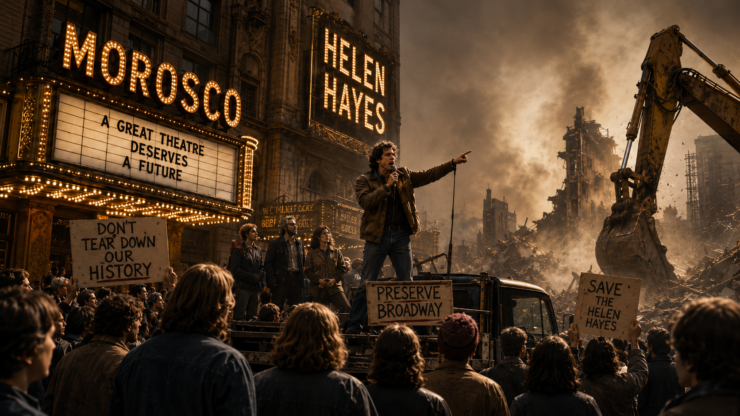
Joe Papp, founder of the Public Theater, knew exactly how to make people pay attention. For weeks, he ran round-the-clock rallies on the empty lot beside the Morosco — at one point staging a 24-hour “dramathon” that cycled through eight plays that had originally premiered in the doomed theaters, Cat on a Hot Tin Roof at 8 p.m., Our Town at 12:30 a.m., The Shadow Box at 3 a.m., and on through the night. Christopher Reeve showed up to support the cause, though his Superman contract with Warner Bros. meant he couldn’t risk getting arrested alongside everyone else. Even Superman has fine print.

March 22, 1982
The last hope was the Supreme Court. Justice Thurgood Marshall — reportedly a theater lover himself — declined to extend a stay on the case. The ruling would stand. The theaters would fall.
That morning, Papp gathered the crowd and explained what would happen: anyone willing to be arrested should walk calmly onto the rubble-strewn lot next to the Morosco, wait for police to ask them to leave, and let themselves be taken in. Nearly two hundred people did it — actors and civilians alike, a group that came to call themselves the “Morosco 200.” As officers loaded them into vans, onlookers sang “Give My Regards to Broadway” and Joni Mitchell’s “Big Yellow Taxi,” repeating the one line that fit a little too well: they paved paradise and put up a parking lot. Among those arrested were Susan Sarandon, Richard Gere, Colleen Dewhurst, Treat Williams, Celeste Holm, Michael Moriarty, Tammy Grimes, and Papp himself.
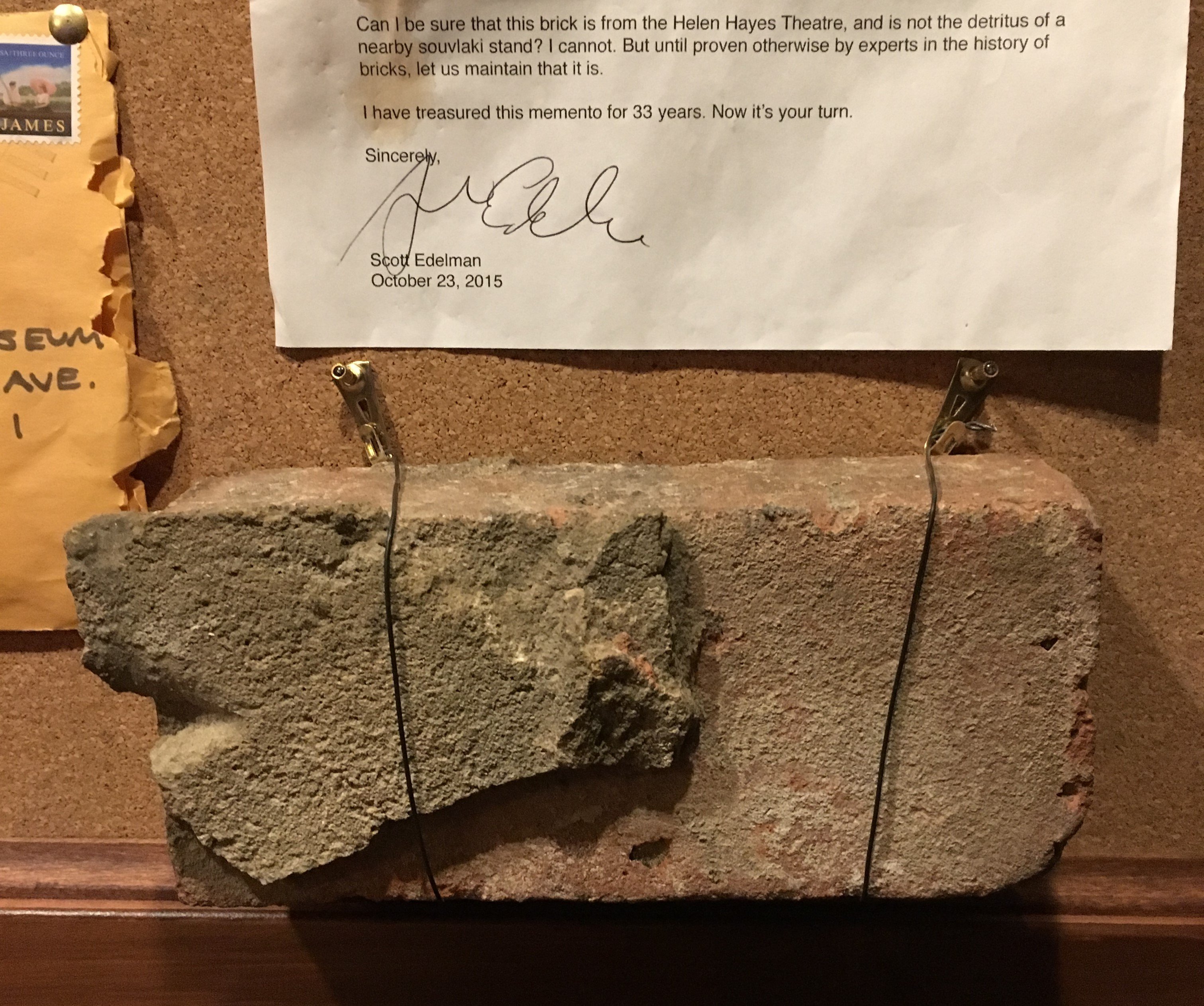
Then came the backhoe. Its operator wheeled it toward the Morosco’s wall with the word GODZILLA painted across the cab, then abruptly stopped and hopped out grinning — he’d known about a twenty-minute legal delay and just wanted to mess with the crowd. When the twenty minutes ran out, and the machine finally lunged at the theater for real, its claw bit air on the first few tries. “Go ahead, fight back, baby,” Colleen Dewhurst shouted from across the street. “The old lady’s putting up a good fight, isn’t she?” She was, for a while. Then a brick seam cracked, a chandelier inside the Morosco began to swing, and the wall gave way.

Losing Changed Everything
The Marriott Marquis opened in September 1985. Tourism and investment did come back to Times Square, more or less as Portman had promised.
But something else happened, too. New Yorkers had just watched historic Broadway theaters turn into rubble, and watched actors and playwrights get arrested trying to stop it. Preservation stopped being an abstract argument about old buildings — people had seen exactly what could disappear, and exactly how fast.
In 1982, only two Broadway theaters had official landmark protection. By 1987, twenty-five did. The Committee to Save the Theaters never saved the Morosco or the Helen Hayes. But it made sure the same thing didn’t keep happening to the theaters that were left.

Broadway Is Full of Ghosts
A show closes, the set comes down, and the actors go home — usually the building is the only thing left standing to prove any of it happened. It took five demolished theaters, years of lawsuits, and a very determined group of Broadway people getting arrested on camera to make New York understand that a theater isn’t just a box you put chairs in. Times Square absolutely needed to change. It just turned out there was a difference between changing a neighborhood and erasing it, and Broadway had to lose two of its best rooms to learn where that line was.