Three translators, one shipwrecked hero — A.O. Scott says the version of Homer’s Odyssey you pick can completely change the experience. Which journey are you taking?
Christopher Nolan’s adaptation of Homer’s Odyssey releases this week (starring a ridiculous cast including Matt Damon, Anne Hathaway, Tom Holland, Zendaya, Robert Pattinson, Charlize Theron, Lupita Nyong’o, Elliot Page, Travis Scott, Jon Bernthal, Mia Goth, Benny Safdie, Corey Hawkins, John Leguizamo, Himesh Patel… if I keep going, this whole post will just be a list of names!) If you plan to read the classic before you see the movie, this is your last chance…
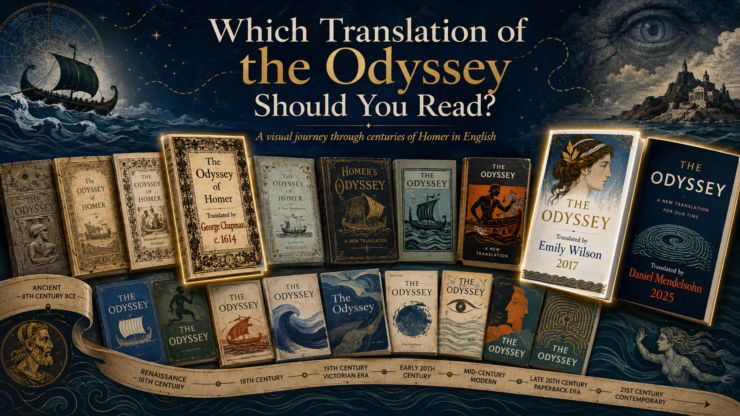
Good or bad, there’s no shortage of English translations of the Odyssey — and picking one can feel a little overwhelming. In a short video from The New York Times, critic-at-large A.O. Scott breaks down three very different translations of the epic poem and who each one is best suited for.
A refresher on what the Odyssey actually is
The Odyssey is, at its core, a wild ride. It’s an ancient Greek poem about Odysseus’s long journey home, packed with romance, adventure, monsters, comedy, and violence — all driven by one man’s desperate need to return to where he belongs.
With that context set, Scott walks through three translations that couldn’t be more different from one another.
1. Emily Wilson (2017) — the modern, accessible choice
Emily Wilson’s 2017 translation was the first major English translation of the Odyssey by a woman, and Scott describes it as clean, clipped, and fast-moving. Her version strips down and simplifies the language while still signaling right away that Odysseus is a psychologically complicated figure — someone who reads as much like an anti-hero as a hero. If you want a version that feels contemporary and moves briskly, this is the one Scott points to.
2. George Chapman (early 1600s) — the poetic choice
On the opposite end of the spectrum is George Chapman’s translation from the early 17th century, written in rhymed pentameter and considered the first major English translation of the poem. Scott calls it the most poetic of the three by far — dense, musical, and unmistakably a poem in its own right. If what you want is a great work of English verse rather than an easy read, Scott suggests Chapman is your best bet.
3. Daniel Mendelsohn (2025) — the closest to the original Greek
The most recent of the three, Daniel Mendelsohn’s 2025 translation, is the one Scott describes as feeling closest to the experience of reading the poem in its original Greek — notable, he adds, coming from someone who doesn’t read Greek himself. It’s unhurried and atmospheric, less concerned with plot efficiency than with casting a kind of spell over the reader.
Why we keep coming back to this 3,000-year-old poem
Scott closes with a broader thought on why ancient Greece — and this story in particular — keeps resonating with modern readers. Part of it, he suggests, is a kind of longing: we live so much of our lives mediated through screens, institutions, and rules that the idea of being out in the world, discovering it firsthand and living by your wits, holds a powerful appeal.
If you’re choosing your first (or next) Odyssey, Scott’s breakdown gives a simple way to think about it:
- Want something modern and readable? Go with Emily Wilson.
- Want gorgeous, old-school English poetry? Go with George Chapman.
- Want to feel closest to the original Greek experience? Go with Daniel Mendelsohn.
Three translators, three very different journeys home — same shipwrecked hero.
![The Book of Fire by Christy Lefteri [Book Review]](https://t1.bookpage.com/wp-content/uploads/2023/11/27145620/bookoffire.jpg "The Book of Fire by Christy Lefteri [Book Review]")