
![Down With the Shipmans by Meg Mitchell Moore [Book Review]](https://ashbydodd.com/wp-content/uploads/2026/08/Down-Shipmans-hero-740x416.png "Down With the Shipmans by Meg Mitchell Moore [Book Review]")
Three sisters, one beloved beach house, and enough emotional baggage to sink the family boat. Down With the Shipmans has all the ingredients for juicy summer drama, but I kept waiting for the story to make bigger waves.
Rating: 3 out of 5 stars
Some books make me want to cancel my plans and keep reading. Others make me think, “This would be a really good six-episode limited series.”
Down With the Shipmans landed firmly in the second category.
Meg Mitchell Moore’s latest novel has nearly everything I should love in a summer family drama: three complicated sisters, a beloved beach house, old secrets, fresh disasters, a difficult rescue dog, and enough emotional baggage to fill several aggressively overpacked SUVs. The New Hampshire coastal setting is lovely, the family dynamics feel lived-in, and Moore remains an engaging writer.
And yet, for some reason, the story never fully clicked for me.
One Last Summer at the Shipman House
It is the week after the Fourth of July, and the three Shipman sisters have returned to their family’s picturesque summer home on the New Hampshire coast.
This is their first reunion since the death of their mother, so emotions are already running close to the surface. Then their father, Calvin, announces that he plans to sell the house.
Naturally, everyone handles this news in a calm, mature, and emotionally healthy way.
Just kidding. They are sisters.
Mae, the youngest, is horrified by the idea of losing the house. She is already struggling with her own emotional scars, a tendency to attract trouble, and a rescue dog whose behavior could generously be described as challenging.
Natalie, the middle sister, has built a large social media following around her seemingly perfect life as a traditional wife and mother. Behind the carefully staged posts, however, her marriage and public image are both beginning to crack.
Jordan, the eldest, works in crisis communications and would prefer to sell the house and move on. Unfortunately, she is also dealing with a professional crisis of her own, proving once again that it is much easier to manage someone else’s disaster than your own.
As the sisters pack up decades of family history, their father’s new wife arrives, adding another layer of tension to an already complicated week. Old memories resurface, long-held frustrations spill out, and the sisters are forced to reckon with what the house means to them now that their mother is gone.
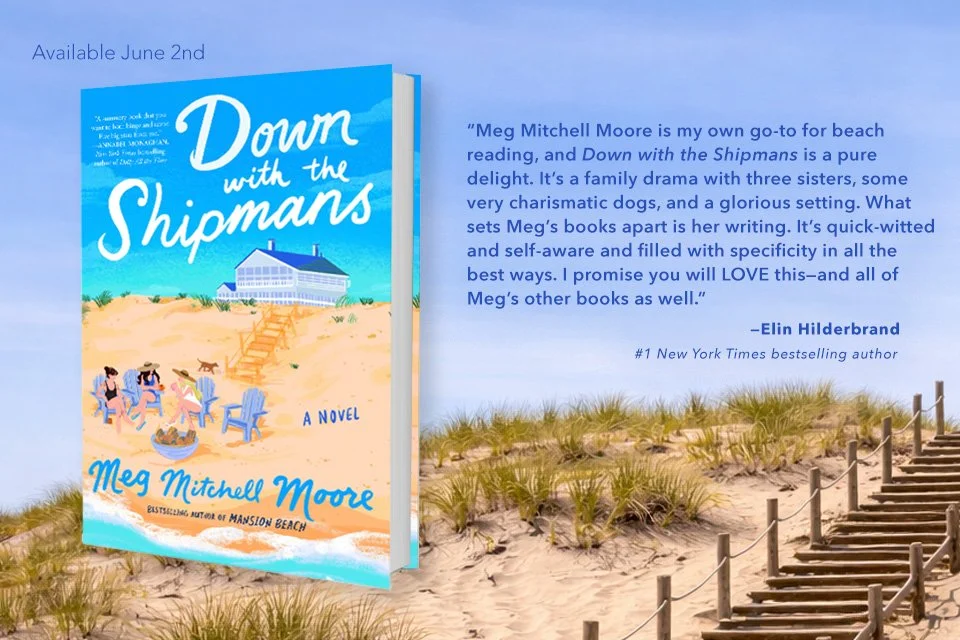
The Shipman Sisters Are the Best Part
The strongest part of Down With the Shipmans is the relationship between Jordan, Natalie, and Mae.
These women feel distinct from one another, with their own flaws, worries, and ways of responding to grief. Their interactions have the mix of affection, irritation, competition, and fierce loyalty that makes fictional sisterhood work.
They know exactly which buttons to push because they helped install them.
Moore also gives each sister a life beyond the beach house’s central question. Natalie’s carefully curated online identity is especially interesting, as the gap between what she presents to the world and what is actually happening becomes harder to maintain. Jordan’s professional confidence masks a much shakier personal reality, while Mae’s messiness makes her unpredictable but also deeply sympathetic.
The family dynamic is written well, and I believed the history between them. Even when they frustrated me, I understood why they were behaving the way they were.
A Perfect Summer Setting
I loved the atmosphere of this book.
The coastal New Hampshire setting feels warm, nostalgic, and just a little melancholy. There is something about a family beach house that comes preloaded with emotion. Every bedroom, chipped mug, and sandy floorboard carries a memory. Selling it is never simply a real estate decision.
Reading this during the summer also felt exactly right. It has the kind of sun-soaked, slightly chaotic energy that belongs in a beach bag, preferably next to sunscreen, snacks, and a towel you will somehow get sand on before reaching the beach.
The setting also supports one of the novel’s strongest ideas: a house can hold a family’s history, but it cannot preserve the family itself.
That is where the story becomes more than a debate over property. The sisters are not only grieving their mother. They are grieving the version of their family that existed when she was alive.

I Kept Waiting for More
My main issue is that I needed more plot.
There are personal crises, family disagreements, and emotional revelations, but much of the book revolves around the sisters reminiscing, unpacking the house, and slowly finding their way back to one another. That is not necessarily a flaw. For readers who love quiet, character-driven family stories, this may be exactly what makes the book appealing.
For me, it was not quite enough.
The novel follows a comforting and familiar family-drama formula, but it rarely pushes beyond it. I kept waiting for the story to become sharper, messier, or more surprising. The ingredients were there, but the emotional stakes never felt as urgent as I wanted them to.
This is also why I think I might enjoy Down With the Shipmans more as a movie or limited series. The coastal setting would look beautiful on screen, the sisters would give three actors plenty to work with, and the family tension could build wonderfully over a handful of episodes.
On the page, though, the pacing felt too gentle for my reading mood.
I have enjoyed Meg Mitchell Moore’s books in the past, and I still like her writing style. She creates characters who feel human, builds appealing settings, and understands the small resentments that can accumulate inside a family.
I am also willing to admit that I may not have been in the right headspace for this particular story. Sometimes a perfectly good book arrives when you are craving something entirely different, and no amount of charming coastal scenery can fix the timing.
Home Is Not Always a House
What stayed with me most was the book’s exploration of grief and the meaning of home.
The Shipman sisters want to preserve the beach house because it represents their mother, their childhood, and a time when the family still felt whole. Letting go of it feels like losing her all over again.
But a house cannot keep people from changing. It cannot prevent marriages from struggling, careers from collapsing, or relationships from becoming complicated. It can hold memories, but it cannot create new ones on its own.
That is the painful truth at the center of the novel. Home is not always the place everyone returns to. Sometimes it is the people who remain after the place is gone.
I liked that idea more than I loved the book built around it.

Final Thoughts
Down With the Shipmans is a warm, thoughtful family drama with well-developed women, believable sister dynamics, and an ideal summer setting. It explores grief, family identity, and the difficulty of letting go of a place entangled with the people you’ve lost.
I wanted a stronger plot and a little more depth in the conflicts, but readers who enjoy quieter novels about sisters, family memories, and finding their way back to the people who know them best may connect with it much more than I did.
Thank you to NetGalley and William Morrow for an advanced reader’s copy. All opinions expressed in this review are my own.

![Finding Me by Viola Davis [Audiobook Review]](https://i.pinimg.com/736x/f0/29/4c/f0294c1ec8e78669984514f69775aef7.jpg "Finding Me by Viola Davis [Audiobook Review]")

![Take Me With You by Steven Rowley [Book Review]](https://ashbydodd.com/wp-content/uploads/2026/06/Take-Me-With-You-hero-370x300.png "Take Me With You by Steven Rowley [Book Review]")