
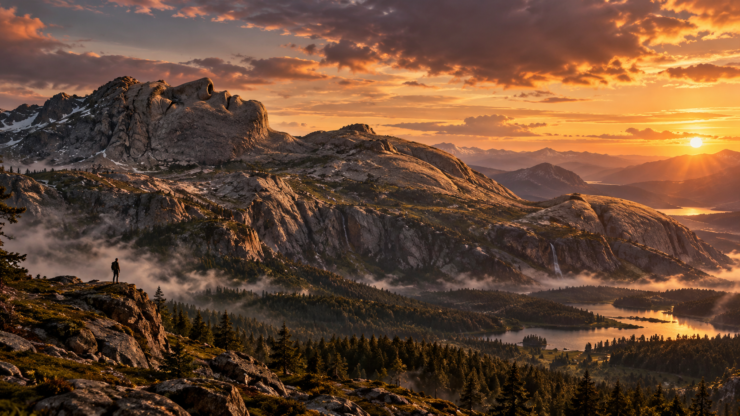
Some people are convinced certain mountains are really the fossilized bodies of ancient giants. Here’s what the rocks actually say.
I love a good conspiracy theory.
Not because I believe it, but because I’m fascinated by the people who do. Give me a suspiciously shaped rock and someone insisting scientists have been lying to us for centuries, and I will lose an entire evening.
Which brings me to petrified giants.
The idea is that some mountains and cliffs are actually the fossilized remains of enormous beings that once walked the Earth. And I don’t mean NBA-player enormous. I mean entire-villages-could-fit-in-their-shoes enormous.
It sounds ridiculous. Then you look at a few photos and think, “Okay, but why does that mountain look so much like a sleeping person?” And suddenly you’re twenty videos deep.
Wait, People Actually Believe This?
Yes. The basic theory is that Earth once hosted gigantic humanoids and animals. When they died, they petrified, and what’s left is the landscape we see today. Cliffs are faces. Rock formations that look like hands or feet are anatomy. Mountains are bodies buried under rock and soil.
And because no conspiracy theory is complete without one, there’s a cover-up. Mainstream science supposedly knows the truth and refuses to say it.
I’ll give it this: the scale is impressive. We’re not talking about one big skeleton someone dug up in the 1800s. We’re talking about looking at a mountain and suggesting it might be somebody’s forehead.
Nature does make some genuinely strange shapes. But looking like something and being that thing are two different questions. Spoiler: it’s not a giant.

The Rocks That Started Raising Eyebrows
The people pushing this theory aren’t always working from blurry photos. Some of the formations they point to are real, well-documented landmarks.
Take Elephant Rock on Heimaey, in Iceland’s Westman Islands. It looks like an elephant lowering its trunk into the ocean. There’s a forehead, an eye, and the unmistakable outline of a trunk. Videos online have claimed it’s the petrified remains of an actual elephant.
A 2022 Lead Stories fact-check looked at that claim and found that the rock is basalt, a volcanic rock, shaped by volcanic activity and ocean waves. The basalt even adds to the illusion, since it looks like wrinkled skin. The same fact-check covered Mokuhooniki, a small Hawaiian island that gets called Elephant Rock from one angle and Turtle Rock from another. It’s a tuff cone, which is made of volcanic ash.
I’m not saying you can’t see an elephant. You absolutely can. But an extraordinary coincidence isn’t evidence that prehistoric elephants were the size of small islands.

The Giant Tree Stump That Isn’t a Tree Stump
If you’ve seen Close Encounters of the Third Kind, you know Devils Tower. It rises from the Wyoming landscape with a flat top and vertical grooves down its sides, and it looks a lot like a tree stump.
So some people say it’s the petrified remains of an impossibly huge ancient tree. The logic goes: it looks like a stump, it has lines like wood grain, and the top looks cut off.
According to the National Park Service, Devils Tower is made of phonolite porphyry, an igneous rock. Its columns formed as molten rock cooled, contracted, and cracked, a process called columnar jointing. Erosion exposed it over millions of years. The Tower stands 867 feet from base to summit and 1,267 feet above the Belle Fourche River.
Geologists still debate some of the details of how it formed, but every theory starts with magma. None of them involve a tree.
I get why people see a stump, though. If someone showed me a photo with no context, I’d say stump too. And then I’d wonder what kind of nightmare squirrels used to live there.

Petrification Is Real, Though
Giant petrified trees do exist. At Florissant Fossil Beds National Monument in Colorado, you can see petrified redwood stumps that are about 34 million years old.
The Big Stump is 12 feet across, and the redwood it came from may have been more than 230 feet tall. A volcanic mudflow buried the tree’s base, and mineral-rich groundwater slowly turned the wood to stone.
And unlike a mountain-sized tree, the Big Stump comes with evidence. Scientists can study it and explain exactly how it happened.
Earth’s real history is already pretty wild. Dinosaurs, giant prehistoric mammals, redwood forests in Colorado. Do we really need mountain-sized people too?
Apparently some of us do.

Why Our Brains Keep Finding Giants
There’s a name for this: pareidolia. It’s our tendency to see familiar shapes, especially faces, in random patterns. It’s why we see faces in clouds, animals in rocks, and a judgmental expression on the front of an electrical outlet.
According to Psychology Today, the brain assigns meaning wherever it can. And once someone points out an eye and a nose, it’s hard to see anything else.
Add dramatic music, a few ominous captions about forbidden history, and a narrator asking why they don’t want you to know the truth, and you’ve got a viral conspiracy video.
The resemblance can be real, even if the explanation is wrong. You really are seeing something that looks like a face. That just doesn’t mean the mountain ever had opinions, a childhood, or a bad run-in with a meteor.
Giants Have Been Around a While
Giants didn’t start with TikTok. Greek mythology has the Titans and the Gigantes, Norse mythology has the Jötnar, and the Bible mentions the Nephilim.
I get the appeal. People have always liked the idea that the world used to be bigger and stranger than it is now. Attach a story like that to a photo of a weird mountain, and it stops being a cool picture and starts being a hidden history.
But mythology isn’t geological evidence. It deserves to be understood on its own terms, not mined for clues.

So, Do I Believe It?
No. We are not walking around on the petrified bodies of ancient giants.
Am I going to stop looking at photos of mountains that resemble sleeping giants? Also no.
I can stare at a mountain, knowing perfectly well it’s a mountain, and still let my imagination wander…
But seriously, why does it have a nose?