

The Tesla Cybertruck is headed for the great junkyard in the sky, and I’ve got a few words for the stainless-steel disaster. Consider this an obituary, not a tragedy.
Dear Cybertruck,
We hardly knew ye.
Actually, that’s not true. We knew far too much about you.
We knew about your windows. And we knew about your accelerator pedals. We knew about the trim pieces that could potentially fly off. And about the recalls. We knew about the price hikes. And we knew about the sales numbers.
Good lord, did we know about the sales numbers.
And now, after several years of roaming American roads looking like a refrigerator designed by someone going through a difficult divorce, the Tesla Cybertruck has finally received its death sentence.
Tesla CEO Elon Musk announced on November 6 that production of the Cybertruck at the company’s Texas factory will wind down around the middle of 2027, clearing space for increased Cybercab production.
So technically, the Cybertruck isn’t dead yet.
But the priest has been called.
The family is gathering.
Someone is quietly asking whether anybody wants the good casserole dish before the estate sale.
It Began With a Broken Window
There are product launches that go badly.
Then there is unveiling your futuristic armored truck, bragging about its supposedly shatter-resistant glass, throwing a metal ball at the window in front of an audience… and watching the window crack. Twice.
That happened during the Cybertruck’s 2019 debut. In retrospect, it feels less like a failed demonstration and more like a prophecy.
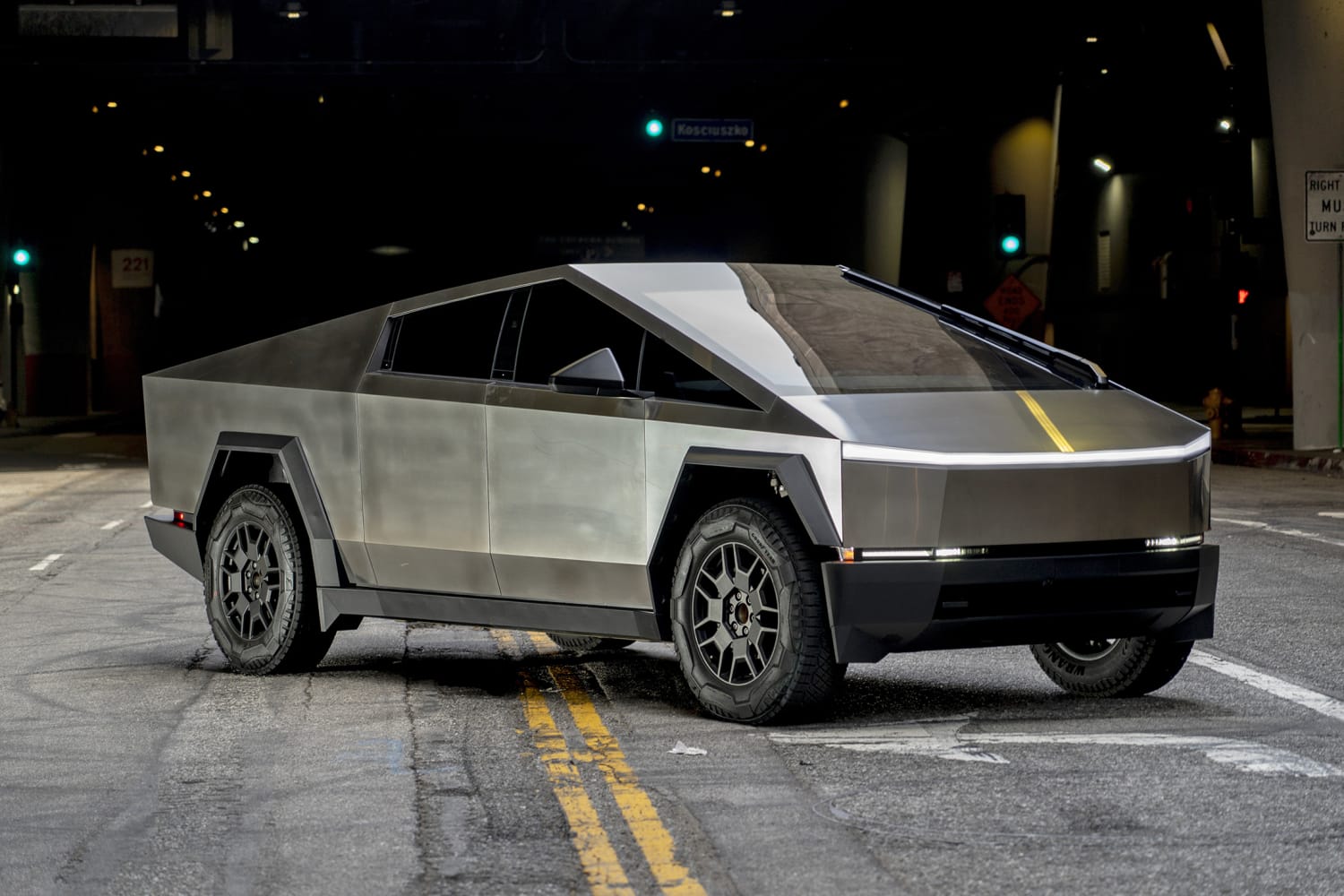
The Cybertruck was introduced as something from the future. It looked like someone had driven directly out of a low-budget 1980s science-fiction movie.
People were fascinated. Hundreds of thousands put down refundable deposits. And Elon Musk predicted Tesla could eventually sell about 250,000 Cybertrucks a year.
There was just one tiny problem. People eventually had to actually buy them.
The Future Was Considerably More Expensive Than Advertised
When Tesla unveiled the Cybertruck in 2019, the entry-level version was supposed to start below $40,000.
That version never really materialized.
By the end, Cybertruck trims were selling for roughly $75,000 to more than $100,000 with fees. Which is quite a jump when the selling point is essentially, “What if a pickup truck looked like the graphics card in your computer?”
And even at those prices, ownership came with its share of adventures.
Since deliveries began in late 2023, the Cybertruck has been involved in 11 recalls, including issues with an accelerator pedal pad that could come loose and a light bar that could detach from the vehicle.
One 2026 recall involved certain Cybertrucks with steel wheels, where cracking could eventually lead to wheel-stud separation and potentially affect vehicle control.
Look, I’m not an automotive engineer. I do, however, prefer my car parts to remain attached to my car. It’s one of my more unreasonable demands.
Then Came the Part Every Hype Machine Eventually Meets: Math
For all the noise surrounding the Cybertruck, the actual sales numbers became increasingly difficult to ignore.
Tesla sold an estimated 38,965 Cybertrucks in 2024.
That dropped to 20,237 in 2025.
Through the first three quarters of 2026, the company had sold just 11,586.
Remember, this was a vehicle once expected to sell around 250,000 units every year.
The Cybertruck Was Never Just a Truck
This is where the story gets a little more interesting than simply pointing and laughing at an enormous stainless-steel polygon.
Because the Cybertruck eventually became more than transportation. It became a statement. Depending on who was driving it, admiring it, mocking it, vandalizing it, defending it, or posting about it online, that statement could mean wildly different things.
It became wrapped up in conversations about wealth, technology, politics, masculinity, Elon Musk, environmentalism, futurism, and whether human beings should be allowed to make a vehicle with corners so sharp.
That is a lot of baggage. And I think that cultural baggage ultimately mattered.
Plenty of ugly, expensive, or unreliable cars have survived. But the Cybertruck somehow became an object that demanded an opinion from almost everyone who saw it.
You didn’t just see a Cybertruck at a stoplight. You had a reaction to the Cybertruck at the stoplight.
And Now, the Cybertruck Rides Into the Extremely Angular Sunset
Musk says Cybertruck production will wind down at Tesla’s Texas Gigafactory around mid-2027 so the company can increase production of its Cybercab robotaxi.
There is technically a small bit of ambiguity here. Musk announced that production in Texas would end but did not explicitly say Cybertruck manufacturing could never move somewhere else. CNBC noted that he did not specify whether the truck would be discontinued entirely.
Still, Texas is where the Cybertruck is made, and multiple automotive outlets are treating this as the end of the line.
Which seems fair.

Farewell, You Ridiculous Stainless-Steel Beast
I will give the Cybertruck this: It was never boring.
Most cars arrive, exist for several years, and quietly disappear from dealerships without anyone outside an enthusiast noticing.
The Cybertruck crashed into public consciousness looking like a doorstop from Mars, broke its own window during its introduction, inspired endless arguments, endured recall after recall, missed its enormous sales ambitions, and will now apparently leave after a remarkably short production run.
So farewell, Cybertruck.
You were too expensive, too troublesome, and you looked like angular scrap metal from a dystopian movie where corporations control the water supply.
You turned every parking lot or road trip into an unsolicited conversation. And somehow, against all odds, you managed to make ordinary pickup trucks look subtle.
May you spend eternity somewhere peaceful, surrounded by charging stations, where I never have to look upon you ever again.
Rest in polygons.