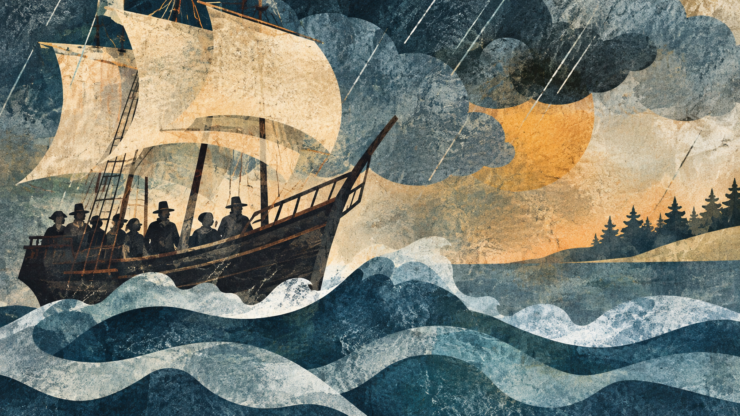
Forget the charming story you learned in school. The Mayflower was basically a 66-day cruise from hell, complete with terrible food, violent storms, and 102 passengers who would’ve killed for a little personal space.
Some pieces of US history get softened by repetition.
The Mayflower is one of them.
Most of us learned a version with Pilgrims, religious freedom, a ship, Plymouth Rock, and a Thanksgiving dinner that somehow required construction-paper hats.
Nobody emphasized how awful the trip itself was.
I don’t mean a long flight with a crying baby. I mean 102 passengers, plus a crew of about 30, on a cargo ship for 66 days, with bad food, constant seasickness, almost no personal space, and a structural beam that cracked in the middle of the Atlantic.
The Mayflower Wasn’t Built for This
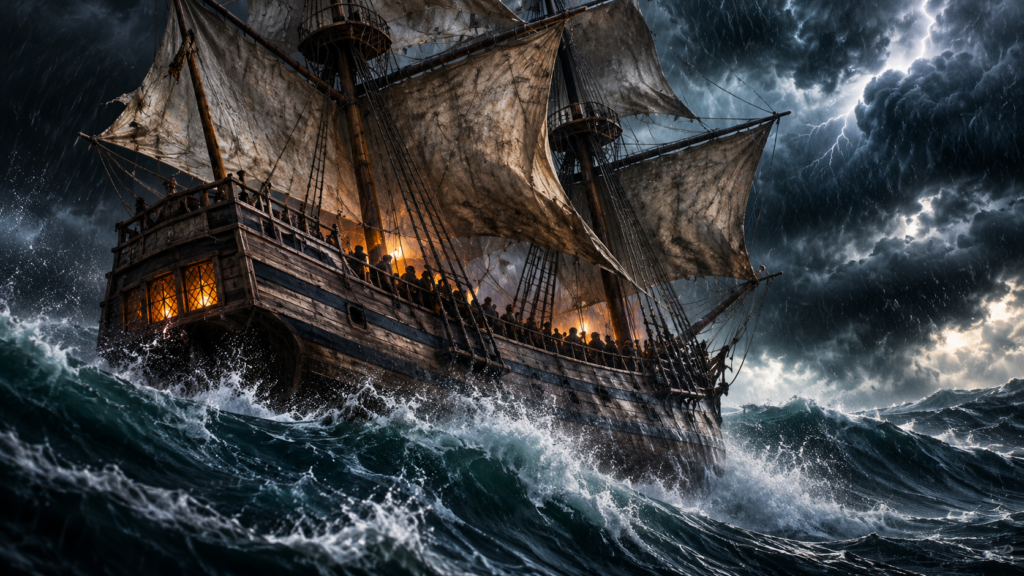
The Mayflower was a merchant ship. It had spent years hauling cargo, mostly wine, and nobody designed it with 100-plus passengers in mind.
The original plan was for two ships, the Mayflower and the smaller Speedwell. The Speedwell leaked. They turned back twice and eventually gave up. Some passengers went home. The rest, along with the Speedwell’s cargo, got crammed onto the Mayflower, which finally left Plymouth, England, in early September 1620, about a month behind schedule.
And don’t picture everyone strolling the deck and gazing at the horizon.
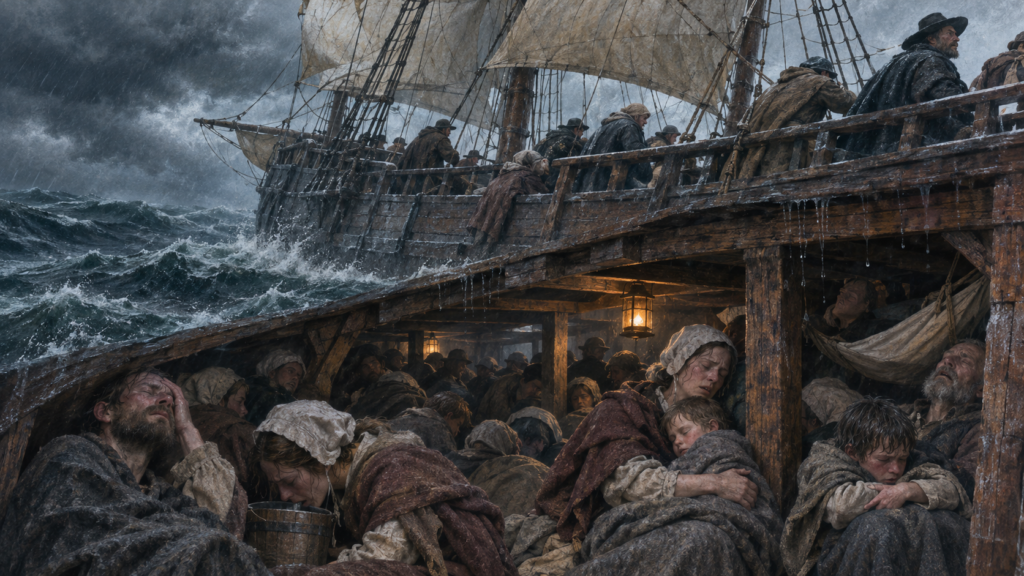
Passengers spent most of the trip on the gun deck, also called the ‘tween deck (no, not that kind of tween). Estimates put the space at roughly 50 by 25 feet with a ceiling around five feet high. There were no windows. The toilets were buckets.
The Mayflower II, the replica docked in Plymouth, Massachusetts, is about 106 feet long and 25 feet wide. Nathaniel Philbrick, who wrote a whole book about the Pilgrims, has said he was immediately struck by how small the ship seemed.

Dinner Wasn’t Exactly Helping
Fresh food didn’t last long at sea. Passengers ate salted meat and hardtack, a dry biscuit, at most meals, and they’d brought beer along.
Now add seasickness, damp wood, bad ventilation, and a lot of people living within feet of each other. It was not a great setup.
Crossing the Atlantic Was Only Part of the Problem
The first half of the crossing was calm. The second half wasn’t.
Storms hit, and at one point a main beam cracked badly enough that people discussed turning back. The passengers had brought a large iron screw, which they used to push the beam back into place, and the ship kept going.
In another storm, a passenger named John Howland went up on deck, was thrown overboard, and grabbed a rope trailing behind the ship. The crew pulled him back in with a boat hook.
Only one passenger died during the crossing, William Butten, a young servant, a few days before land was sighted. One baby, Oceanus Hopkins, was born at sea. So the Mayflower arrived with the same 102 people it left with.
That almost sounds triumphant. It didn’t stay that way.

They Didn’t Even Arrive Where They Were Supposed To
The Mayflower wasn’t even headed for Plymouth. They actually planned to settle farther south, near the Hudson River. But when they tried, they hit dangerous shoals and bad weather and turned back north. In November they anchored at Cape Cod, in what’s now Provincetown Harbor.
That created a problem. Some passengers argued that since they’d landed outside the territory covered by their patent, nobody had any real authority over anybody.
So before they went ashore, 41 adult men signed the Mayflower Compact, an agreement to form a government and follow laws made for the colony’s general good.
Imagine surviving two months in a wet wooden box, finally seeing land, and immediately having to sit through a governing meeting.
It’s usually described as an early step in American self-government, which it was. It was also a group of exhausted people realizing they needed rules before things got out of hand.
And Then Winter Arrived
This is the part that’s harder to romanticize.
Landing didn’t fix anything. They still had to find a place to settle and build shelter during a Massachusetts winter. They picked the Plymouth site in December, and many people stayed aboard the ship while houses went up. Sickness spread fast through people who were already weakened.
By spring, about half of the passengers were dead. Of the 18 adult women who made the crossing, 13 didn’t survive the winter.
This is also where the neat childhood version needs more context.
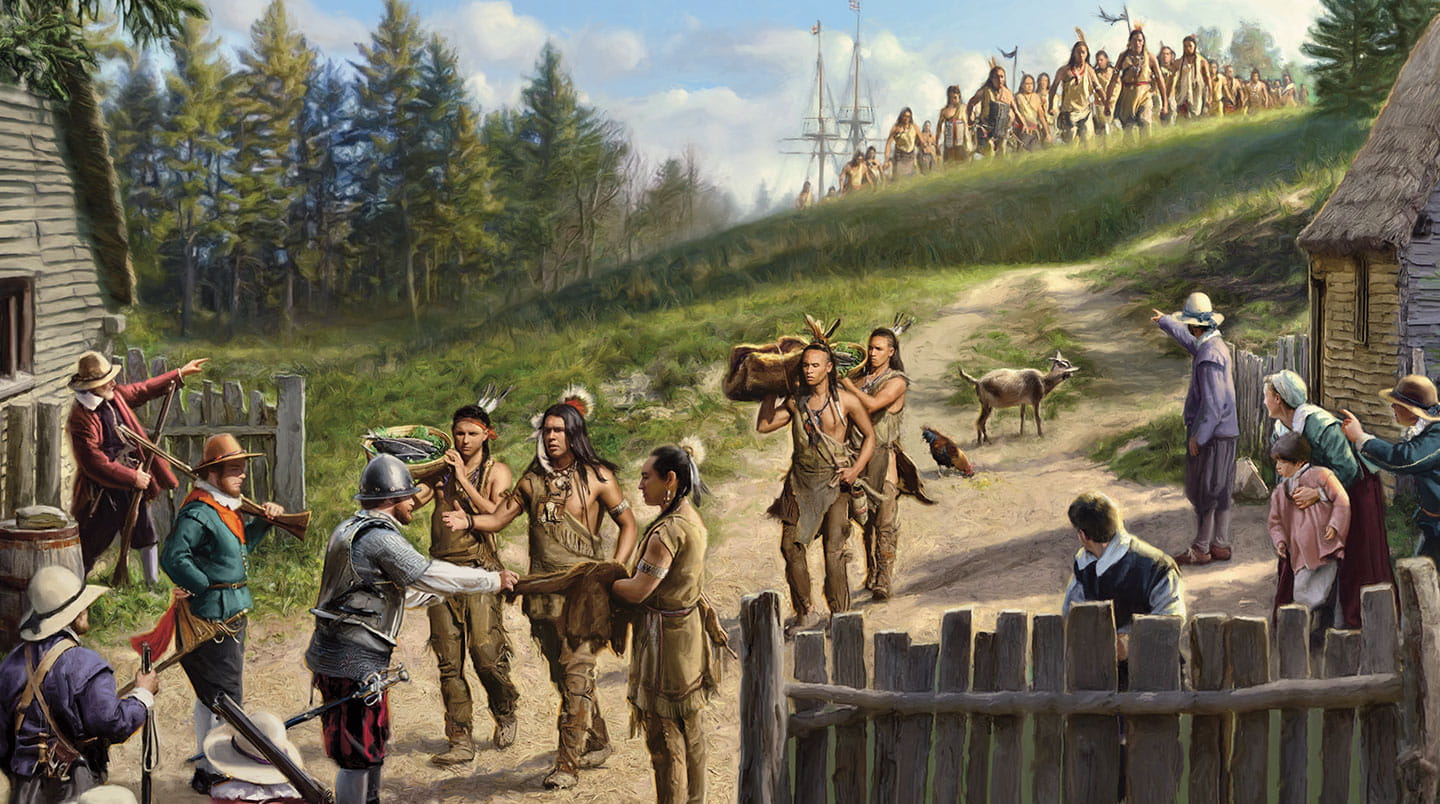
The English didn’t land in an empty wilderness. Plymouth was built on the site of Patuxet, a Wampanoag village emptied by epidemic disease in the years before the Mayflower arrived. Native communities across the region had already been hit hard by diseases that came with European contact. The colonists who survived relied on help from the Wampanoag, including Tisquantum, also known as Squanto, who was from Patuxet himself.
What happened between the colonists and the Wampanoag after that is a lot more complicated than the elementary-school version.
Plymouth Rock Might Not Even Be Plymouth Rock
None of the Mayflower passengers ever mentioned Plymouth Rock in their writing.
The first claim that it was the landing spot came in 1741, 121 years later. The town planned a wharf that would have buried the rock, and a church elder named Thomas Faunce, in his mid-nineties, said his father and some of the original passengers had pointed it out to him. His father arrived in 1623, three years after the Mayflower. Faunce was carried to the rock in a chair to say goodbye.
Nobody can confirm any of that. The Pilgrims also first landed at Provincetown, not Plymouth.
So one of the story’s most recognizable symbols comes down to an old man’s memory of what his dad told him. That feels very American.
(Not to mention, these days, the infamous rock is pretty unimpressive in person. Don’t make a special trip if you’re expecting something worth seeing.)
The video below gives a good visual sense of how cramped and miserable the voyage would have been.
I would not have survived the Mayflower.