Swanson had 260 tons of extra turkey and a country suddenly obsessed with their glowing television. That combination changed how Americans eat dinner.
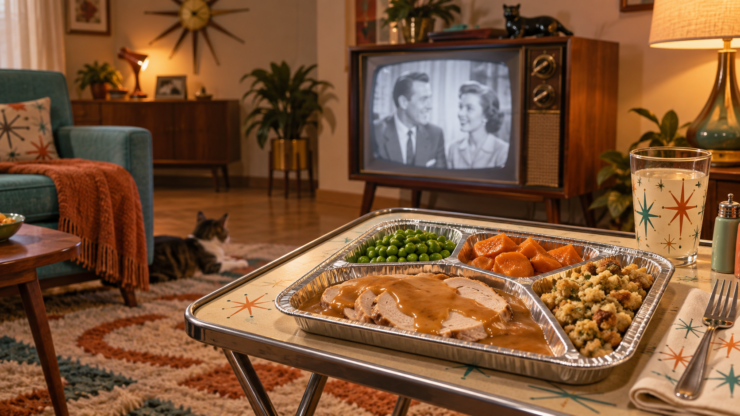
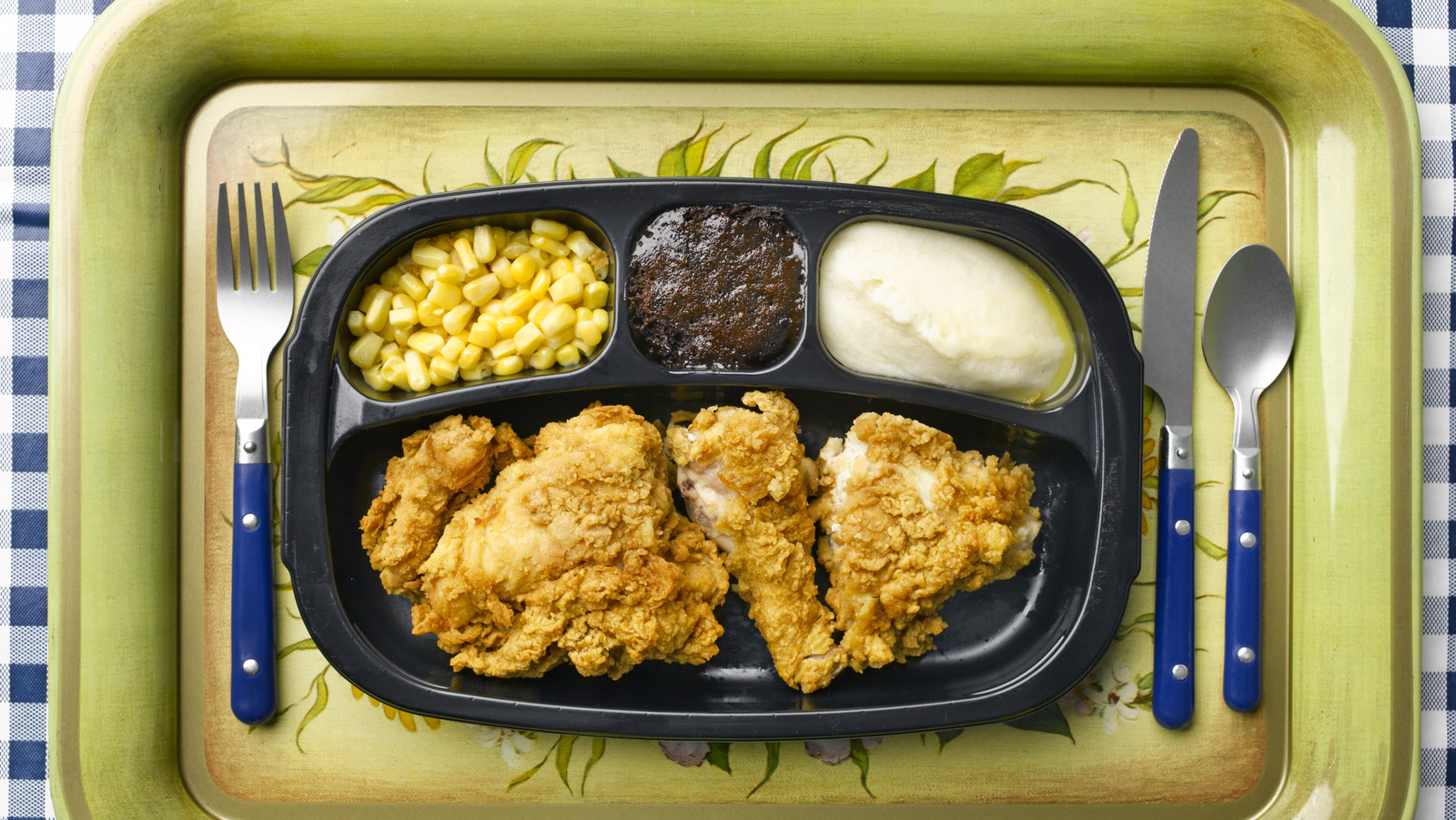
Frozen Salisbury steak, eaten out of a compartmentalized aluminum tray while I Love Lucy plays in the background, doesn’t sound like a turning point in American history. But, as far as dinner was concerned, it was.
Today, microwaving a frozen meal barely counts as cooking. In 1953, pulling an entire dinner out of the freezer, heating it in one container, and throwing the whole thing away afterward felt like science fiction. Getting there took a company that made trays for airplanes, a frozen turkey company surplus, and one of the most disputed origin stories in food history.

Before the TV Dinner, There Was the Airplane Dinner
Swanson didn’t invent frozen food, and it didn’t even invent the frozen tray dinner. That distinction belongs to Maxson Food Systems, which developed the Strato-Plate in 1945: a three-compartment frozen meal built for military and commercial airline passengers, complete with a custom onboard oven to reheat it.
A few years later, brothers Albert and Meyer Bernstein picked up a version of the idea. In 1949, they launched Frozen Dinners, Inc. in Pittsburgh, selling a three-compartment aluminum tray meal under the name One-Eyed Eskimo. By 1950 they’d sold over 400,000 of them, all within the Pittsburgh area.
So Swanson didn’t dream up frozen food out of nowhere. It just did it on a much bigger scale.
260 Tons of Turkey (Allegedly)
In 1953, C.A. Swanson & Sons badly overestimated how much turkey Americans would buy for Thanksgiving. They ended up with about 260 tons of frozen turkey sitting in ten refrigerated railroad cars. Because the refrigeration only worked while the trains were moving, the cars supposedly shuttled back and forth between Nebraska and the East Coast while executives tried to figure out what to do with all that meat. Eventually, the leftover turkey became the basis for a complete frozen meal, divided into a three-compartment tray.
It’s a great story. It also might not be entirely true. Swanson’s TV Dinner hit store shelves on September 10, 1953, which is before that year’s Thanksgiving, not after it. Some food historians and business writers have pointed out that this makes the “leftover turkey” timeline nearly impossible, and Gerry Thomas, the Swanson salesman usually credited with the idea, later suggested the turkey surplus was more of a metaphor for the company’s turkey-selling struggles than a literal trainload of birds. Worth keeping in mind next time you see this story repeated as fact. Including, arguably, right here.

So Who Actually Invented It?
For decades, Thomas was credited as the inventor, claiming he’d seen airline-style trays at a distributor’s warehouse and sketched out a three-compartment version for his bosses. He was later inducted into the Frozen Food Hall of Fame for it.
But other people at Swanson tell a different story. Brothers Gilbert and Clarke Swanson also claimed credit, saying they got the idea from a tray they saw on a business flight. And Swanson bacteriologist Betty Cronin, later nicknamed the “Mother of TV Dinners,” solved the genuinely hard science problem of getting turkey, stuffing, vegetables, and potatoes to finish cooking at the same time, in the same tray, without turning half the meal to mush.
There’s no single, undisputed inventor. What isn’t in dispute is that Swanson packaged, branded, and marketed the idea hard enough to make it a household name.

The Marketing Was the Real Genius
Swanson’s real advantage wasn’t the food. It was timing.
Television ownership exploded through the 1950s, climbing from roughly one household in ten in 1950 to more than half by the middle of the decade to nearly nine in ten by 1960. Swanson looked at that shift and pitched dinner as something you could eat in front of the new family altar without any guilt about it.
The original packaging looked like a miniature television set, complete with fake knobs and screen-style graphics. The name did the rest of the work: “TV Dinner” made reheated turkey sound futuristic instead of like leftovers with better branding.
98 Cents and 10 Million Dinners Later
The first Swanson TV Dinner sold for 98 cents and was ready in about 25 minutes in the oven. (Swanson was cautious and produced only a few thousand trays at first.)
Americans bought around 10 million of them in the first full year. Not everyone was thrilled. There were plenty of complaints that frozen dinners were killing the family meal in favor of staring at a screen, an argument that will sound extremely familiar to anyone who has ever had an opinion about phones at the dinner table.
America Gets a TV Tray
Once people started eating dinner in front of the television, furniture had to catch up. By the 1960s, the folding metal TV tray table was a fixture in American living rooms: unfold it, set your steaming tray on top, and settle in for the evening.
Swanson kept expanding the menu beyond turkey, adding chicken, Salisbury steak, and meatloaf, along with “international” dinners aimed at Americans getting curious about food beyond meat and potatoes. How authentically international any of it actually was is a separate question. A 1970s “Polynesian Style” dinner was not, by any account, making chefs in Polynesia nervous.
Then Came Hungry-Man
By 1973, Swanson decided the standard TV dinner needed more meat and, apparently, more masculinity. Hungry-Man dinners launched with noticeably larger portions, aimed squarely at men, on a marketing pitch that basically amounted to “are you hungry, here is more food.” It worked.
By the 1980s, the category had split into opposite extremes: Lean Cuisine targeted people who wanted a lighter meal, and Hungry-Man doubled down on the opposite idea.
What’s kind of remarkable, looking back, is how much of today’s frozen aisle traces back to a turkey surplus story nobody can quite verify. The trays got fancier, the marketing got weirder, and eventually the microwave changed the whole game again. But the basic pitch Swanson made in 1953, that dinner didn’t have to cost you an evening, is still exactly what’s selling in that freezer case today.