
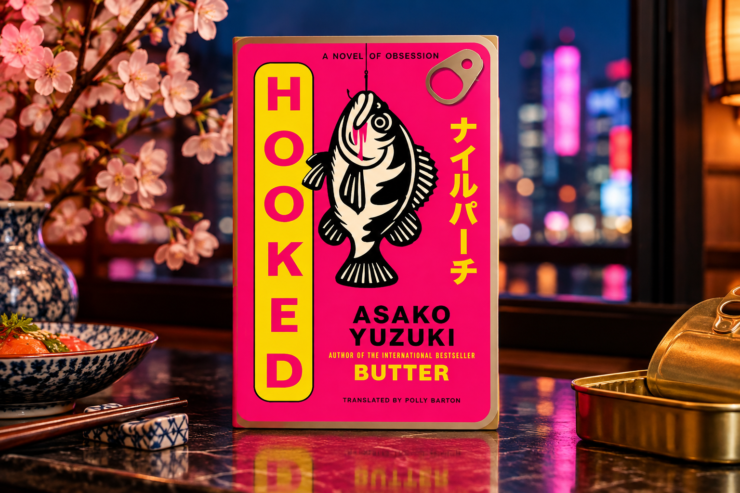
What starts as an unlikely friendship slowly becomes a masterclass in blurred boundaries, bad decisions, and the very human fear of being alone.
Rating: 3.25 out of 5 stars
Some friendships make your life better; some quietly run their course; and some make you want to take both people by the shoulders gently and suggest they spend some time apart.
Hooked by Asako Yuzuki falls very firmly into the third category.
Translated by Polly Barton, Hooked is a strange, uncomfortable story about loneliness, female friendship, obsession, and the exhausting pressure to look like you have your life completely under control. It is also a book where an ordinary coffee date can somehow feel like the emotional equivalent of watching someone lean farther and farther back in a chair.
You know what’s coming. You just don’t know exactly when it’ll go wrong.

Two Very Different Versions of “Fine”
Eriko appears to have everything figured out.
She has a prestigious job at a Japanese trading firm, a spotless apartment, supportive parents, and an ambitious new project to reintroduce Nile Perch into the Japanese market. From the outside, she looks polished, capable, and enviable.
She is also deeply lonely.
Eriko has never been able to maintain a close friendship, and that absence has become harder and harder to ignore. Then she discovers Shoko, a popular lifestyle blogger whose writing about food, marriage, and everyday contentment becomes a regular part of Eriko’s life.
Shoko’s world looks almost nothing like Eriko’s.
Her apartment is messy. Dinner might come from a takeout container. Her husband is kind and easygoing. Her blog makes a virtue out of the small pleasures and imperfections of daily life, even as Shoko carries her own emotional baggage, particularly around her fractured relationship with her father.
Eriko becomes fascinated with her.
Then fascination becomes something else.
She arranges what is supposed to be a chance meeting, and before long the two women are attempting something neither seems especially equipped to handle: friendship.
A Deeply Uncomfortable Friendship
Eriko and Shoko are not exactly competing for a “healthiest approach to friendship” award.
Their relationship gets messier, needier, more competitive, and more invasive, but what kept me interested is that Yuzuki never reduces either woman to a collection of red flags. Their loneliness gives their worst decisions emotional weight, even when those decisions are difficult to watch.
And they are difficult to watch.
Yuzuki has a real talent for making perfectly ordinary interactions feel vaguely threatening. A blog update. A meal. A coffee date. None of these things should require an emotional emergency exit, and yet somehow Hooked makes you want to locate one.
The tension comes from blurred boundaries and mismatched expectations. One woman thinks a moment means one thing. The other thinks it means something completely different.

Loneliness Is Doing a Lot Here
What makes Eriko and Shoko’s relationship interesting is that neither woman simply wants a friend.
They want reassurance.
Eriko sees Shoko as proof that a different kind of life might make her happier. Shoko, in turn, is drawn to qualities in Eriko that complicate her own sense of identity and success. They are looking at each other as both an answer and a measuring stick, which is a fairly terrible foundation for emotional stability.
But it also feels recognizable.
There’s smart commentary here on female friendship and the pressure of womanhood, especially the expectation that you should be successful, socially fulfilled, emotionally secure, and somehow make it all look effortless.
Eriko and Shoko have very different versions of apparent success, but neither seems especially reassured by the other’s.
That is the part of Hooked I found most compelling. Yuzuki is interested in why these women become so invested in each other, but also why friendship itself starts to feel like something they can succeed or fail at.
Apparently even finding a friend can become another thing you’re supposed to win.

I Got It. I Just Needed the Book to Move
My biggest issue with Hooked is that it occasionally seems reluctant to trust the reader.
The loneliness is clear. The insecurity is clear. The increasingly unhealthy attachment is very clear.
And then we spend a lot more time circling all three.
There were stretches when the repetition stopped building tension and started making the story feel stuck. I understood that these women needed boundaries. I understood that things were becoming unhealthy. And I understood that nobody involved should be making major friendship decisions without perhaps first going for a very long walk alone.
I just wanted the book to move.
That repetition kept me from being more enthusiastic about a novel that otherwise gave me a lot to think about.
Final Thoughts
Hooked is uncomfortable in a way that feels intentional, and for the most part, effective.
I did not always enjoy spending time with Eriko and Shoko, but I was interested in them. Their relationship is unsettling because Yuzuki grounds the obsession in recognizable feelings: loneliness, comparison, insecurity, and the desperate hope that another person might finally make you feel less alone.
It is messy, occasionally frustrating, and much more perceptive than its most extreme moments might suggest.
I would recommend it, particularly if you like character-driven novels about complicated women behaving badly for reasons that make more sense than you would probably like them to.
Thank you to NetGalley and Ecco for an advanced reader’s copy. All opinions expressed in this review are my own.
![The Lost House by Melissa Larsen [Book Review]](https://mpd-biblio-covers.imgix.net/9781250332875.jpg "The Lost House by Melissa Larsen [Book Review]")
:max_bytes(150000):strip_icc():focal(749x0:751x2)/bethany-joy-lenz-one-tree-hill-dinner-for-vampires-102224-8ba3c1085a3b48c38557b4c7ea982aa8.jpg "Cults, Secrets, and One Tree Hill: Bethany Joy Lenz’s Memoir")

![The Upcycled Self by Tariq “Black Thought” Trotter [Book Review]](https://patch.com/img/cdn20/users/26370361/20231108/123853/2023-12-02-black-thought-970x606___08123851306.jpg "The Upcycled Self by Tariq “Black Thought” Trotter [Book Review]")