
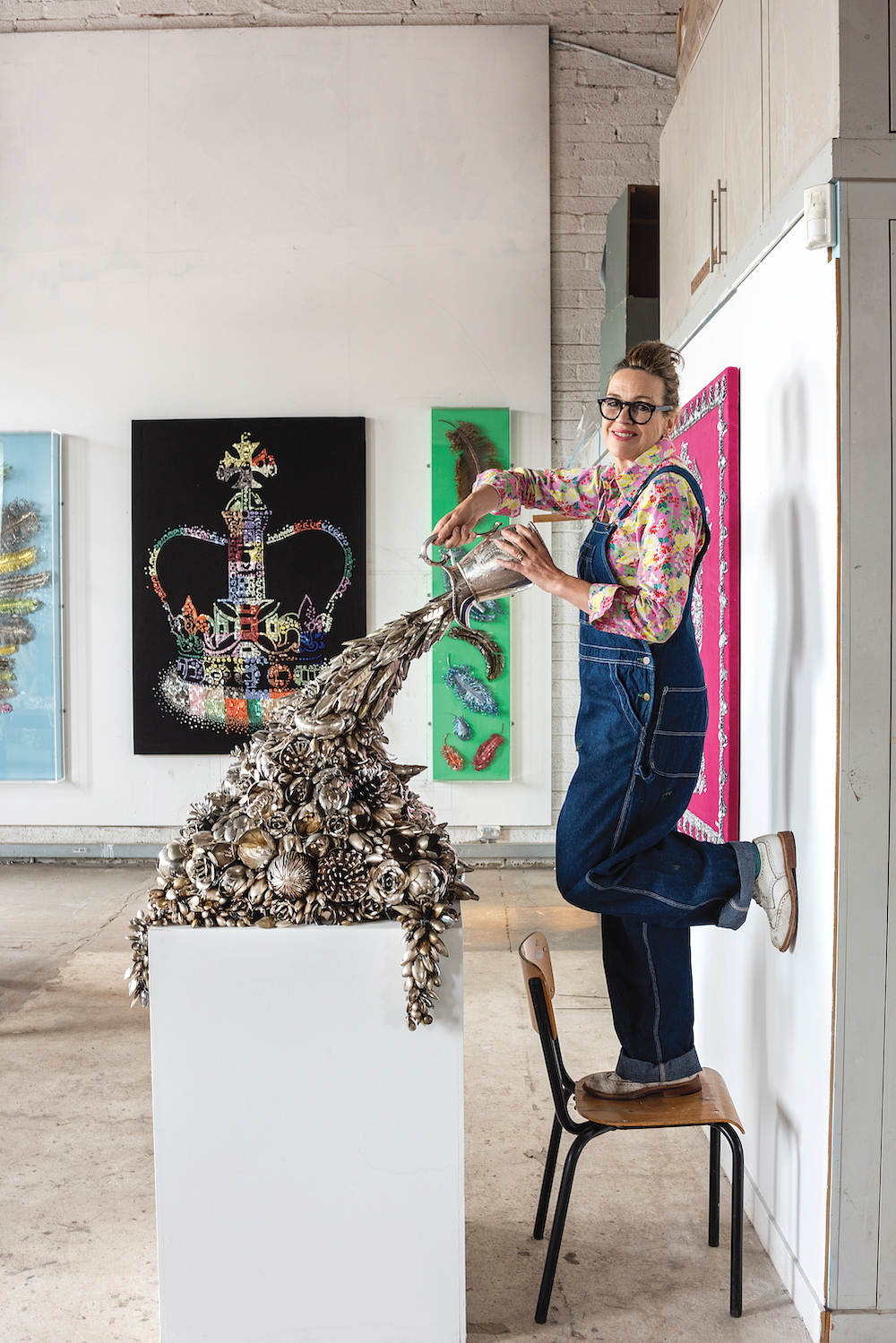
British artist Ann Carrington builds bouquets from hundreds of spoons and once made a banner for the Queen out of half a million buttons.
I have a drawer full of things I should probably throw away. Old keys, random buttons, coins from trips I barely remember, and a piece of jewelry I haven’t worn in years but can’t bring myself to toss.
Ann Carrington would get it. She has spent her career making sculpture out of objects that already had lives before they reached her studio in Margate, England: spoons, military buttons, coins, and safety pins.
Where the Materials Come From
Carrington buys from auction houses and antique shops, and a cutlery dealer finds the rest. She has said she might order 10,000 teaspoons or 500 fish knives at a time. Whatever she doesn’t use goes back to be melted down.
She describes all objects as “saturated with cultural meaning,” and that’s what makes her work interesting to me. A fork already comes with a history of dinners, holidays, and somebody’s silver drawer.

Bouquets Made of Cutlery
Her best-known pieces are floral arrangements built from silverware. Soup spoons become peonies, teaspoons become rose petals, and fork tines become protea blooms.
From a distance, it looks like flowers. Up close, you’re looking at hundreds of utensils, and it’s hard not to think of every Sunday dinner you’ve ever sat through.
One of these, Devil’s Trumpet, was shown at her 2016 solo exhibition at the Royal College of Art and then acquired by the Victoria and Albert Museum, where it’s on display in the silver galleries. The V&A says it was inspired by memento mori in 17th-century Dutch still-life paintings, which fits a bouquet that will never wilt.

Pearly Queens and a Half Million Buttons
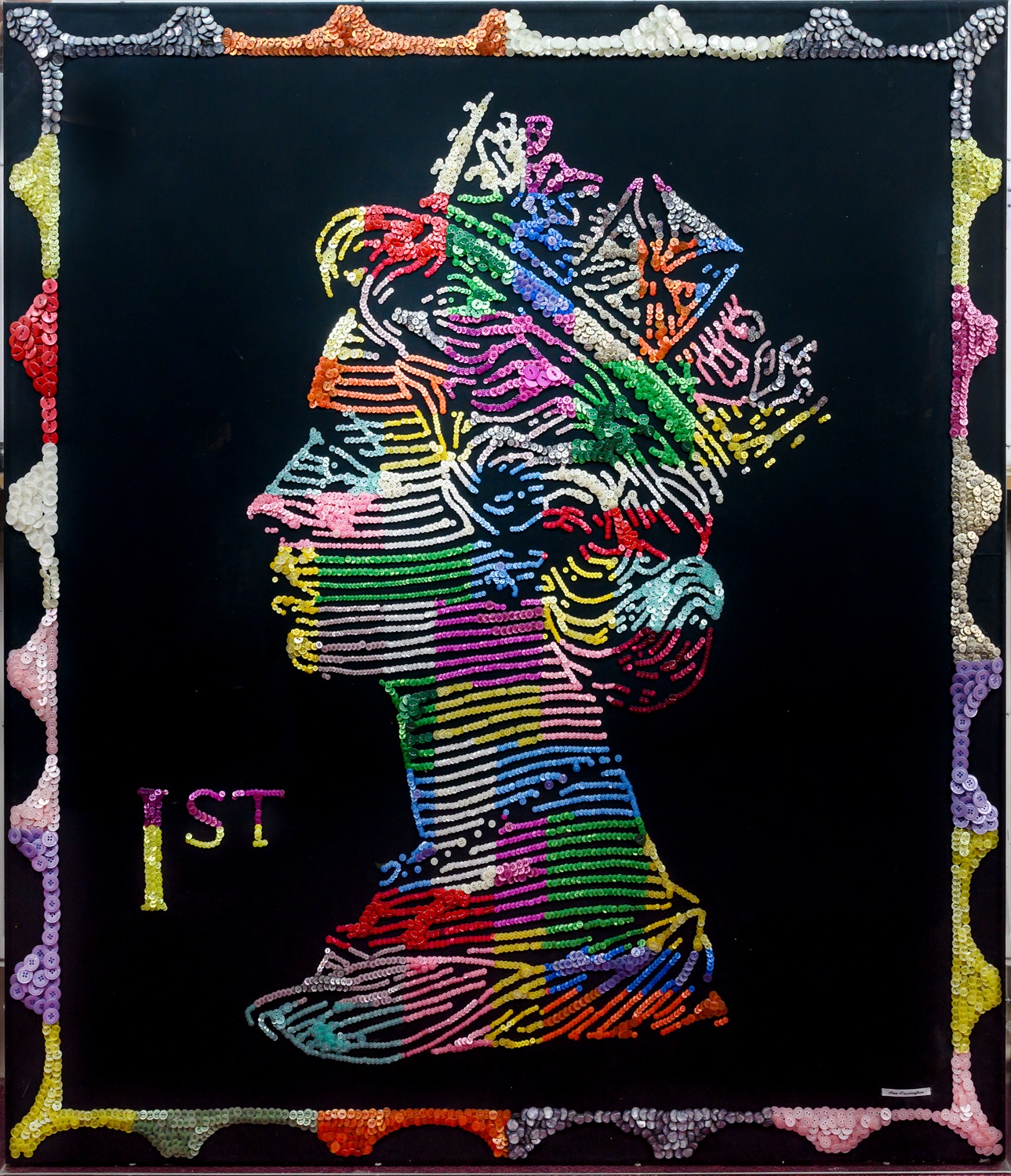
Her Pearly Queens series nods to London’s Pearly Kings and Queens, who cover their clothes in pearl buttons. Carrington sews buttons into portraits based on Queen Elizabeth II’s profile from the postage stamp, and Royal Mail has licensed her to make art in that form.
In 2012, she was commissioned to create the Royal Jubilee Banner for the Queen’s Diamond Jubilee. It hung from the stern of the royal barge, the Spirit of Chartwell, during the Thames pageant. The banner is embroidered with more than half a million gold buttons, a mix of modern hand-dyed ones and old military buttons supplied by the Army and Navy. The border, worked in metallic thread, runs from William I in 1066 to Elizabeth II.
Half a million buttons is a lot. What I like is that they’re old uniform buttons and pearl buttons and a royal crown all in one piece. It’s history made from things people actually wore.
Found, or Rescued
Carrington calls her materials found. I’d say rescued, though some spoons were probably fine being spoons. Objects tend to disappear once nobody needs them for their original purpose, and she looks at a box of old silverware at an estate sale and sees something to work with.
My drawer is safe for now. You can see more of Carrington’s work on her website.
Sources: Ann Carrington, Victoria and Albert Museum, V&A Blog, Homo Faber, Vintage News
Image: Architectural Digest