
The 1908 novel gave us Anne Shirley, but the 1985 miniseries made her feel real. Here’s what changed between the book and the adaptation that raised a generation.
If you grew up watching PBS in the late ’80s or early ’90s, the 1985 CBC miniseries Anne of Green Gables is probably baked into your personality somewhere. Directed by Kevin Sullivan and starring Megan Follows in what remains one of the most perfectly cast roles in television history, it aired as part of PBS’s Wonderworks programming block and became — and remains — the most-watched Canadian television program ever made. It spawned three sequels and a spin-off series (Road to Avonlea, which ran until 1996), and it gave an entire generation of kids the distinct impression that Prince Edward Island was a spiritual destination.
I still revisit it. No apologies.
But the miniseries and L.M. Montgomery’s 1908 novel, while telling the same story, are genuinely different experiences. The adaptation is remarkably faithful by any reasonable standard. Where it differs from the book, though, it usually differs for a reason — and those choices add up to something with a different center of gravity than Montgomery’s original. Here’s what actually changed.
Anne Is Older — and It Shifts Everything
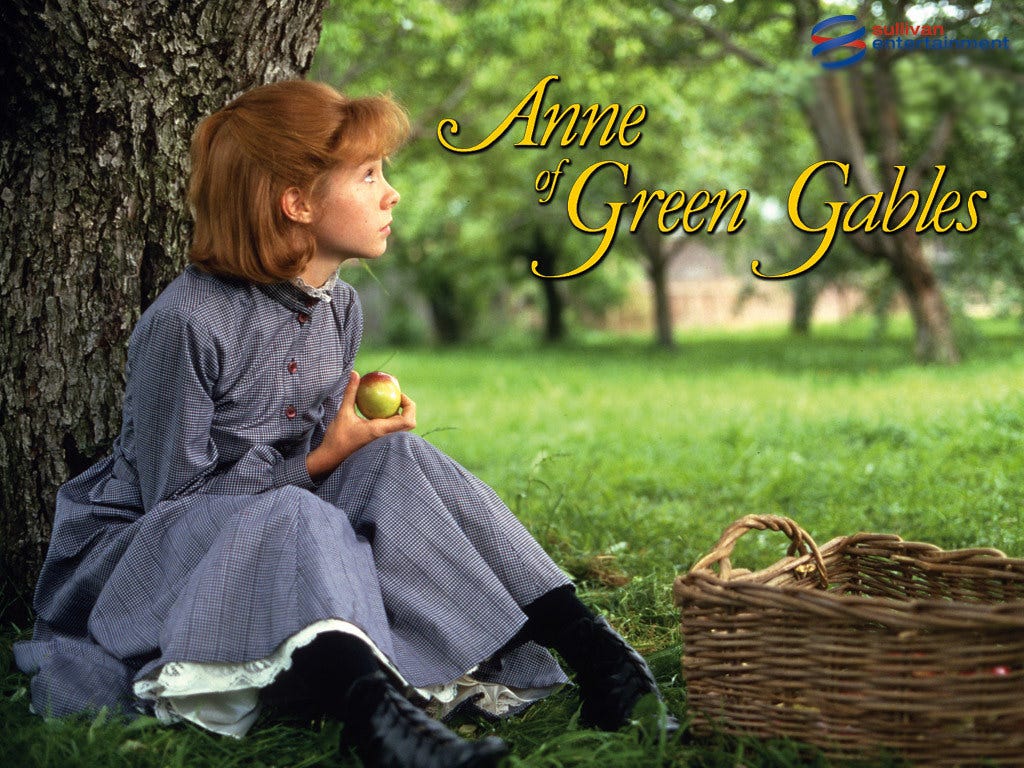
In the book, Anne arrives at Green Gables at the age of eleven. The story follows her to roughly sixteen. She is a child, and the novel never lets you forget it.
Megan Follows was seventeen when the miniseries filmed, and the character reads accordingly — a teenager, not a little girl. That shift is subtle in some places and enormous in others. Most significantly, it rewrites the entire Gilbert Blythe situation.
In Montgomery’s novel, Anne genuinely does not understand for years that Gilbert might like her. She thinks everything he does is designed to annoy her. She invented the rivalry. The miniseries — very reasonably — plays the dynamic as a romantic will-they-won’t-they from early on, letting the audience in on something Anne isn’t admitting to herself. Jonathan Crombie is so good in the role that this works. But it’s a meaningfully different story than the one where Anne, age eleven, is simply, completely, and somewhat hilariously oblivious.

The Miniseries Opens Before the Book Does
Montgomery’s novel begins with Mrs. Rachel Lynde sitting at her window, watching Matthew Cuthbert drive past in his buggy, looking unusually dressed up, and immediately setting out to find out why. We are in Avonlea from the first sentence.
The miniseries opens earlier, with Anne herself, still in her previous life with the Hammond family, distracted by a Tennyson poem while failing to deliver Mr. Hammond’s lunch to the mill. Mr. Hammond dies. Anne gets sent back to the orphanage. We watch it happen.
In the book, all of this exists only through Anne’s own telling of it — delivered in her characteristically dramatic, packed, and heartbreaking way during the carriage ride with Matthew. She narrates her own sad history so briskly and matter-of-factly that the sadness sneaks up on you. There’s also more of it than the miniseries includes: Anne’s parents, both teachers named Bertha and Walter Shirley, died of fever when she was an infant. Before the Hammonds, there was a Mrs. Thomas, whose husband was an alcoholic. Anne’s imaginary friend “Katie Maurice” was a reflection in a glass-fronted cabinet — the other pane had been broken by Mr. Thomas in a rage. The miniseries gives Anne a hard past. The book gives her a harder one and makes her tell you about it herself.

Why Anne Dyes Her Hair Green
Both versions contain the hair-dye disaster — Anne buys dye from a traveling peddler who promises raven-black hair but ends up with green, and Marilla cuts it all off. Classic Anne.
But the trigger is different. In the miniseries, Anne dyes her hair as a direct response to Gilbert calling her “Carrots” at school. She smashes the slate over his head; she also, apparently, decides to become someone without red hair.
In the book, the hair-dye incident is entirely separate — it happens much later, out of simple, ongoing vanity about her appearance, with no connection to Gilbert whatsoever. Anne’s hatred of her red hair predates Gilbert by the length of her entire childhood. His “Carrots” comment is what makes her hate him, not what drives her to the peddler. In the miniseries, she’s reacting to Gilbert even before she’d ever admit he exists to her. The book’s Anne would not give him that much credit.

The Puffed-Sleeve Dress
In the book, Matthew notices at the Christmas concert rehearsal that Anne is the only girl in the room without fashionable puffed sleeves. He goes to Samuel Lawson’s store to buy her a dress, but is too shy to actually purchase one — he comes home with a bag of brown sugar instead. He eventually enlists Rachel Lynde to make him a dress.
In the miniseries, Anne wears the dress to a Christmas ball (not a concert), and it’s a store clerk named Alice Lawson who helps Matthew select it rather than Rachel Lynde. It’s a small change, but Rachel Lynde secretly helping Matthew do something kind for Anne is a character trait missing from most of the miniseries.

Marilla’s Decision to Keep Anne
In the book, Marilla makes up her mind to keep Anne after meeting Mrs. Blewett — the unpleasant woman who would take Anne in as free child labor — and decides she can’t in good conscience leave the girl with her.
In the miniseries, Marilla reconsiders after meeting Mrs. Blewett, but doesn’t make a final decision until Anne smashes the slate over Gilbert’s head at school and dyes her hair. It’s at this point that Marilla tells Anne she’s decided to keep her permanently. It’s a more dramatic beat, and it works as television. But it changes Marilla’s motivation from a quiet moral reckoning to a response to Anne’s spirit, which is warmer and slightly less interesting.
Matthew’s Death
In both the book and the miniseries, Matthew’s death is triggered by the news that a bank failure has wiped out the Cuthbert savings. Heart attack. That part is consistent.
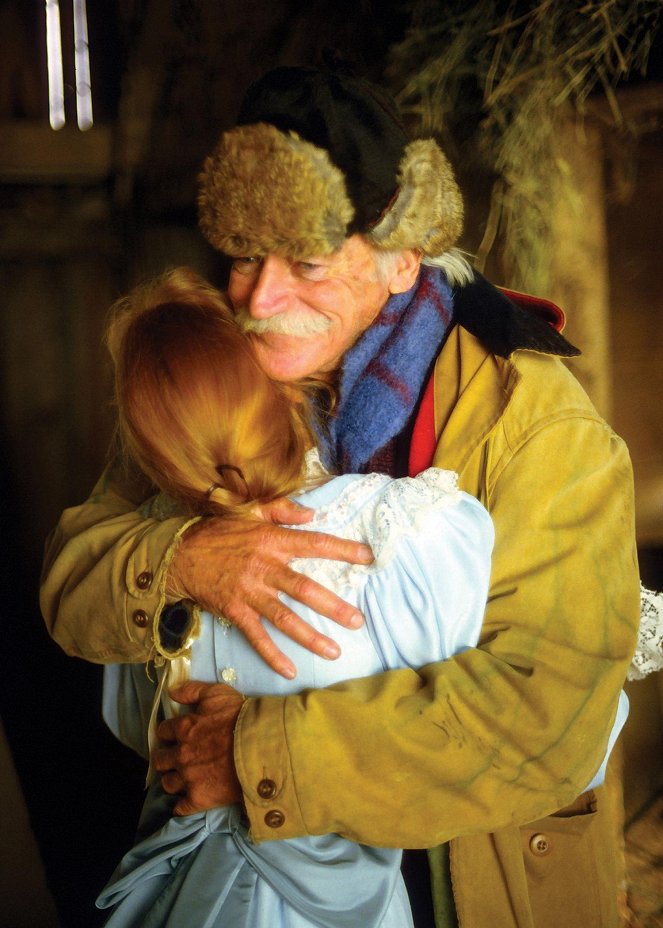
What’s different is the goodbye. In the book, Matthew’s death is sudden — he collapses, and that’s it. Anne doesn’t get a farewell. The loss hits hard partly because of how little warning there is.
In the miniseries, Matthew has a heart attack while working in the field and gets a final heartfelt conversation with Anne before he goes. Richard Farnsworth is so gentle in this role that it would be churlish to object. It’s a beautiful scene. But it softens something Montgomery wrote deliberately as hard.
One late scene that does make it in — because Colleen Dewhurst insisted on it — is the moment after Matthew’s funeral when Marilla tells Anne she loves her. Sullivan has written that Dewhurst flagged it during filming and pushed for its inclusion. That one stays, and it’s the right call.

Gilbert Delivers the Exam Results
In the book, Diana tells Anne her Queen’s Academy entrance exam results when Anne is back home at Green Gables.
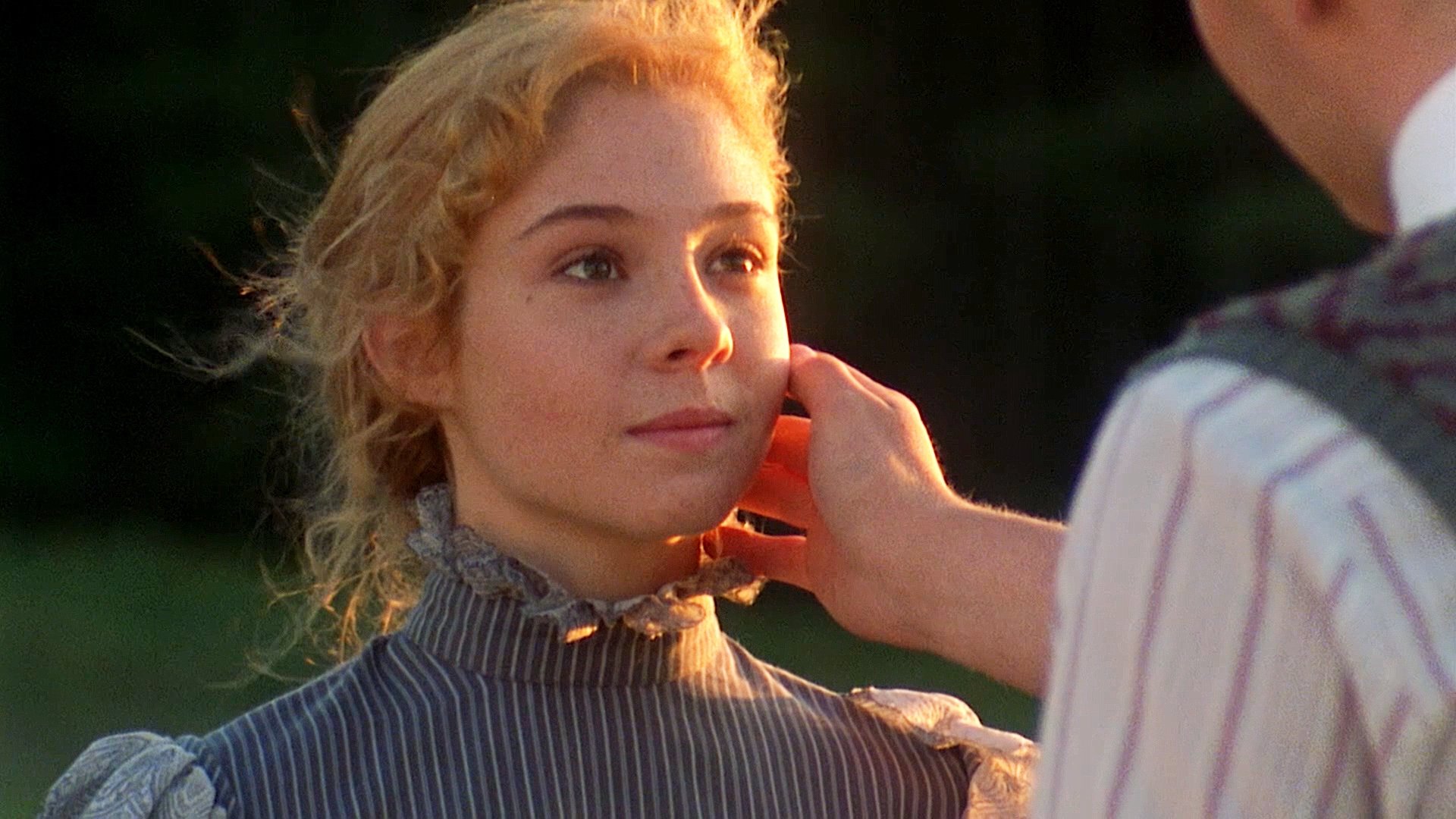
In the miniseries, Gilbert tells her — immediately after rescuing Anne from the pond, where she had climbed onto a bridgepole after Mr. Barry’s boat sprung a leak mid-dramatic-poem-reenactment. He rows her to shore, reveals they’ve tied for first in the exams, and asks her to forgive him.
The miniseries is not going to let a good rescue scene go to waste. Fair enough.
What to Know Before You Start
If you’ve only seen the miniseries: the book is funnier, darker in backstory, and richer in Anne’s interior life. Montgomery’s prose is the whole point — Anne’s voice on the page, with all her dramatic opinions and sensitivity and absolute certainty that the world owes her puffed sleeves, is what the entire thing is built on. It’s also worth knowing that the book’s Anne is genuinely oblivious to Gilbert for years in a way the miniseries can’t quite replicate, and that obliviousness is one of Montgomery’s best jokes.
If you’ve only read the book: the casting in the miniseries is exceptional across the board. Megan Follows is Anne in the way that only happens a few times in an adaptation’s history. The miniseries plays warmer and more romantic than the novel, and it earns it. And Richard Farnsworth will make you cry in the last twenty minutes, regardless of how prepared you think you are.
The book was published in 1908, rejected by five publishers before anyone took it. The miniseries is the most-watched Canadian television program ever made.
Both of them were right about Anne.

![The Guest by Emma Cline [Book Review]](https://www.washingtonpost.com/wp-apps/imrs.php?src=https://arc-anglerfish-washpost-prod-washpost.s3.amazonaws.com/public/MRFDA2O3TZA2ZEPHI7JQLKU4GI_size-normalized.jpg&w=1440 "The Guest by Emma Cline [Book Review]")