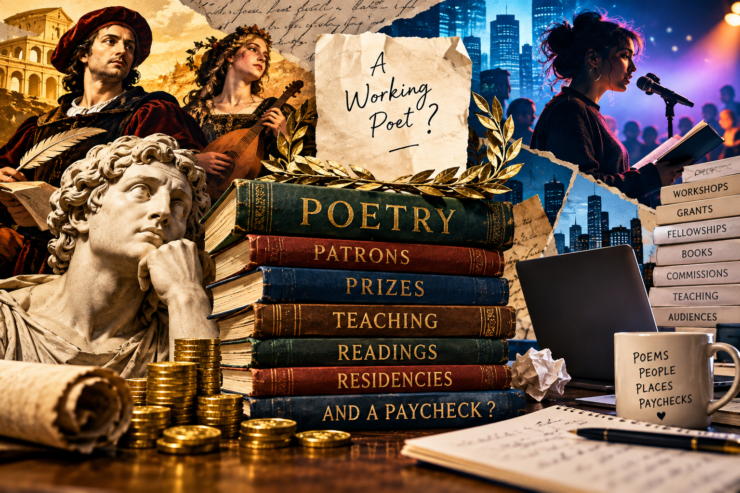
Poets have been chasing patrons, prizes, teaching gigs, and actual paychecks for centuries. So can poetry still be a profession, or has “working poet” always come with an asterisk?
The muse has never once cared about health insurance. Turns out that’s been true for about three thousand years.
I started wondering what it would actually take to be a professional poet today — not someone with a notebook full of half-finished sonnets, but someone who can say “poet” as their job without immediately adding, “well, I also…”
Professional poets absolutely exist. They publish books, teach, perform, win fellowships, hold residencies, serve as poets laureate. But making a living just writing poems is a different question. Turns out it always has been.
Poetry Used to Do a Lot More Jobs
Before novels and Netflix and TikTok were competing for our attention, poetry told stories, preserved history, and entertained people at parties, sometimes all in the same performance. In ancient Greece, it was tied to music and theater: Pindar wrote victory odes for aristocrats who’d just won at the games, and at the big Athenian dramatic festivals, the city itself paid the actors and playwrights, while a wealthy citizen called a choregos covered the chorus and costumes. West African griots preserved genealogy and history as performers and advisers to rulers. In imperial China, poetry was so tied to the educated scholar-official class that many of its most famous poets earned their living through government service, not poetry sales.
Nobody was getting rich selling individual poems. Societies valued poets. They just didn’t necessarily pay for the poems themselves.

Then Rome Invented the Patron
Ancient Rome gave us the model most people still picture: find someone rich. The statesman Maecenas became so famous for bankrolling writers like Virgil and Horace that his name is still shorthand for an arts patron in several languages. Horace also worked a government job as a scribe, so even poetry’s golden age of patronage had a day job quietly holding it up. Sponsored content is not exactly new.
Medieval troubadours ran a version of the same system: gifts and support from aristocratic courts, minus the guaranteed paycheck. Swap “traveling from castle to castle” for “applying to residencies and festivals,” and the industry hasn’t changed as much as we’d like to think.
Eventually, Someone Invented a Salary
Renaissance poets were prestigious and mostly broke. No royalty system existed yet, so Shakespeare’s contemporaries paid rent as playwrights, translators, secretaries, and clergymen. The real fix came from the poet laureate: John Dryden became England’s first official, salaried laureate in 1668. The U.S. followed in 1937 with a Library of Congress poetry consultancy, renamed Poet Laureate Consultant in Poetry in 1986. Both jobs are real, both come with prestige and money, and neither is exactly abundant — there’s only ever one at a time.
The One Era Poetry Was Basically Pop Culture
For a while, poets really were mass-market celebrities. Lord Byron’s Childe Harold’s Pilgrimage sold out its first print run of 500 copies in three days, back in 1812. Alfred, Lord Tennyson was reportedly one of the three most famous living people in Victorian Britain, right up there with Queen Victoria and Prime Minister Gladstone — his 1864 collection sold more than 40,000 copies almost immediately and earned him upward of £8,000 in its first year alone. Henry Wadsworth Longfellow made enough from his poetry that he resigned his Harvard professorship in 1854 to write full-time.
Byron, Tennyson, and Longfellow prove a real commercial poetry market has existed. They don’t prove it was ever easy for the average poet.
So What Happened to Poetry?
Novels, newspapers, recorded music, film, TV, and eventually the internet all picked up jobs poetry once did alone. The appetite for compressed, rhythmic language never went anywhere — it’s still in our songs, our speeches, the stray line someone screenshots off their phone. We just stopped calling all of it poetry.

What It Actually Takes Now
Poetry magazine, one of the field’s most prestigious outlets, currently pays $500 for a published poem. Which is a nice bonus, but that’s all it is. The Authors Guild’s 2023 survey found full-time authors had an average book income of just $10,000 in 2022. Poetry-specific numbers would likely run lower still.
Grants help more. The NEA gives out 35 poetry fellowships of $25,000 each, chosen from a pool of more than 2,000 applicants. The Academy of American Poets hands out a $25,000 fellowship, $50,000 laureate fellowships for poets serving in civic roles, and a $100,000 Wallace Stevens Award. That’s real money, but it’s a prize, not a salary — nobody’s budgeting next year’s rent around a panel of judges liking their line breaks.
So most working poets stitch it together: teaching, readings, workshops, grants, a day job, book sales, often all in the same year.

The Actual Answer
If “make a living as a poet” means living entirely off what readers pay for your poems, almost nobody manages it. If it means building a career around poetry, poets have been doing exactly that for centuries. Horace had a government job. Longfellow taught at Harvard until he no longer needed the paycheck. Modern poets do the same thing with grants and freelance work instead of a Roman patron. The side job was never proof the poetry wasn’t serious.