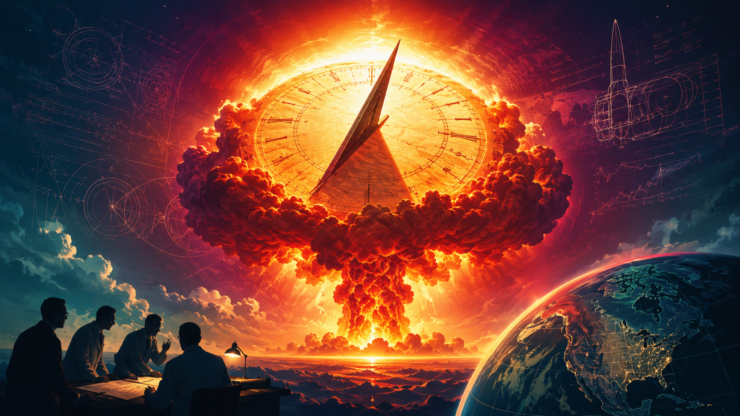
There are bad ideas, and then there’s the idea to build a nuclear bomb so powerful that a scientist in the room warned it could contaminate the Earth. This is Project Sundial.
It sounds like the setup to a grim sci-fi movie. It isn’t. It’s a real topic of discussion dating back to the summer of 1954.
In July of that year, physicist Edward Teller walked into a secret meeting and pitched two enormous thermonuclear weapons: Gnomon and Sundial. Gnomon would produce an explosion equivalent to 1,000 megatons of TNT. Its job was to then trigger Sundial — a proposed 10,000-megaton weapon.

The Cold War Search for “Much Bigger Bangs”
By the summer of 1954, the U.S. was already deep into a terrifying phase of the arms race. Just months earlier, the Castle Bravo hydrogen bomb test had gone off at 15 megatons — far more than scientists expected. The fallout spread across inhabited parts of the Marshall Islands and forced evacuations downwind.
You’d think that might be the moment everyone paused.
Instead, Teller showed up to a secret meeting of the Atomic Energy Commission’s General Advisory Committee and said he wanted to discuss “much bigger bangs.” That’s an actual phrase preserved in the meeting record — one of the few parts not buried under redactions.
What survived was enough. Gnomon alone would have out-yielded any nuclear weapon ever tested. Sundial would have been ten times bigger than that. For comparison: the Soviet Union’s Tsar Bomba, still the largest nuclear weapon ever detonated, produced a 50-megaton explosion in 1961. Sundial’s proposed yield was 200 times that.
Even the Nuclear Scientists Were Alarmed
What’s unsettling about the archived meeting notes is how ordinary they are. No one flips a table. No one announces that humanity has lost the plot. At first, the minutes seem so normal — lab programs, weapon development, scheduling — and then the discomfort sets in.
Physicist James Fisk reportedly asked how much of the Livermore lab’s effort was going toward Gnomon and Sundial. Walter Whitman was “shocked” at the thought of a 10,000-megaton weapon and warned it would contaminate the Earth. I.I. Rabi, for his part, waved the whole thing off as an “advertising stunt.”
I wish he’d been right. Livermore kept working on Gnomon for several more years and even considered testing a prototype during Operation Redwing in 1956. That test never happened, and neither weapon was ever built — but this was clearly more than one scientist’s napkin doodle.
A 1963 study estimated that a 10,000-megaton weapon, detonated about 28 miles above the Earth, could ignite fires across an area roughly 500 miles wide — about the size of France. At that scale, the usual models for predicting nuclear damage just stop working.
This Wasn’t Just One Man’s Terrible Idea
It’d be easy to hang Project Sundial entirely on Edward Teller. He was famously all-in on thermonuclear weapons and rarely seemed rattled by the idea of building something bigger. But pinning it on one enthusiastic scientist lets everyone else off too easily.
What’s actually alarming is that an idea this destructive got a codename, lab resources, technical discussion, and a tentative path to testing. Officials were asking, “Can we build it?” instead of “Should we build it?”
The people living downwind of Castle Bravo had already learned, the hard way, that fallout doesn’t respect test boundaries or confident calculations. The search for something bigger kept going anyway.
Project Sundial was never completed. It sat buried in classified files and redacted meeting notes — one of the darker footnotes of the Cold War.

![The Quick History of Ballet in Russia [Dance Lesson]](https://www.princetonmagazine.com/wp-content/uploads/2022/01/fdc070dd-76b7-4545-beed-2ebaf72e2a2f-Swan_Lake.jpg "The Quick History of Ballet in Russia [Dance Lesson]")
